
Nerd stuff · Hunting ethics
How far is too far to shoot a deer?
The gate that runs out first is not the one everybody argues about.
Quick answer
There is no single yardage. For a .308 Winchester 175 gr load, our engine holds 1,000 ft-lbs to 631 yards on a whitetail, but the bullet drops below its 1,800 fps expansion speed at 500 yards, so 500 is the terminal limit. Then take the shorter of that and the range where you can still put the bullet in a 10 by 12 inch vital zone. Placement decides the rest.
Hunters have argued the energy question for a century, usually in ft-lbs and usually about deer. It is a good question with an incomplete answer, because a bullet has to do two separate things when it arrives: carry enough energy to reach the vitals, and still be moving fast enough to open up. We ran one hunting rifle through our ballistics engine to find where each of those runs out, and the two answers are not the same distance.
631yd
Where this .308 load drops under 1,000 ft-lbs, the common whitetail energy floor.
500yd
Where the same bullet slows past 1,800 fps and can no longer be counted on to expand.
395yd
Where the load stops meeting the elk energy floor. Bigger animal, shorter answer.
Gate 1
What the bullet has left when it gets there
Retained energy is the honest version of caliber talk. It is what the bullet still carries at the animal rather than at the muzzle, and it stands in for the work the bullet has to do: drive through hide, bone and lung, and reach the far side. Drag takes it away faster than most people picture. This .308 leaves the muzzle with about 2,730 ft-lbs and arrives at 600 yards with 1,059, which is under 40 percent of what it started with.
The bands behind the curve below are the ones Wrist Dope uses for a whitetail: a 1,000 ft-lb floor, with the rating stepping up at 1.25 times that floor and down at 0.85 times it. Those are published hunting rules of thumb, drawn from the tables and state minimums that have been in print for decades. They encode an opinion. They are not measurements.
Retained energy against the whitetail energy gate
.308 Win, 175 gr, G7 BC 0.243, 2,650 fps, 100-yard zero, standard sea-level air.
See the numbers
| Distance | Impact velocity | Retained energy | Energy gate, whitetail |
|---|---|---|---|
| 100 yd | 2,466 fps | 2,362 ft-lbs | Ideal |
| 150 yd | 2,376 fps | 2,194 ft-lbs | Ideal |
| 200 yd | 2,289 fps | 2,036 ft-lbs | Ideal |
| 250 yd | 2,203 fps | 1,886 ft-lbs | Ideal |
| 300 yd | 2,120 fps | 1,746 ft-lbs | Ideal |
| 350 yd | 2,038 fps | 1,613 ft-lbs | Ideal |
| 400 yd | 1,957 fps | 1,489 ft-lbs | Ideal |
| 450 yd | 1,879 fps | 1,371 ft-lbs | Ideal |
| 500 yd | 1,801 fps | 1,261 ft-lbs | Ideal |
| 550 yd | 1,726 fps | 1,157 ft-lbs | Adequate |
| 600 yd | 1,651 fps | 1,059 ft-lbs | Adequate |
| 650 yd | 1,578 fps | 968 ft-lbs | Marginal |
| 700 yd | 1,507 fps | 882 ft-lbs | Marginal |
| 750 yd | 1,436 fps | 802 ft-lbs | Insufficient |
| 800 yd | 1,368 fps | 727 ft-lbs | Insufficient |
| 850 yd | 1,301 fps | 658 ft-lbs | Insufficient |
| 900 yd | 1,236 fps | 594 ft-lbs | Insufficient |
| 950 yd | 1,174 fps | 535 ft-lbs | Insufficient |
| 1000 yd | 1,116 fps | 484 ft-lbs | Insufficient |
Read on the energy gate alone, this load is Ideal on deer to 504 yards, Adequate to 631, and Marginal to 719. Move up to elk, whose floor is 1,500 ft-lbs, and the same curve gives out at 395 yards. Nothing about the rifle changed. The animal did.
Gate 2
The gate most people forget
A hunting bullet kills by expanding. Slowed past a certain impact speed it stops opening reliably and behaves more like a solid, poking a caliber-sized hole and leaving a thin blood trail. That threshold is a property of how the bullet is built, not of the animal, and around 1,800 fps is the widely published floor for standard cup-and-core bullets. Bonded and premium designs open lower, nearer 1,600 fps. The app rates every load against 1,800 fps, because it cannot see what is in your chamber and would rather be pessimistic than flattering.
Put the two gates side by side and the ranking flips depending on what you are hunting.
How far each gate reaches, same rifle and load
Last distance the gate still passes. The rating takes the shorter of the two.
See the numbers
| Animal | Energy floor | Energy gate holds to | Expansion gate holds to | Rating stays Adequate to | Gate that runs out first |
|---|---|---|---|---|---|
| Whitetail deer | 1,000 ft-lbs | 631 yd | 500 yd | 500 yd | Expansion velocity |
| Elk | 1,500 ft-lbs | 395 yd | 500 yd | 395 yd | Retained energy |
On deer, energy is not the binding limit. This load carries deer-floor energy 131 yards farther than it carries expansion speed, so the honest cap is 500 yards, not 631. On elk the order reverses: the bullet is still expanding well past the range where it has stopped carrying enough energy for an animal that size, and the cap is 395. Whichever gate is thinner sets the number, and which one that is changes with the quarry.
In the app
What the rating says, and what it refuses to say
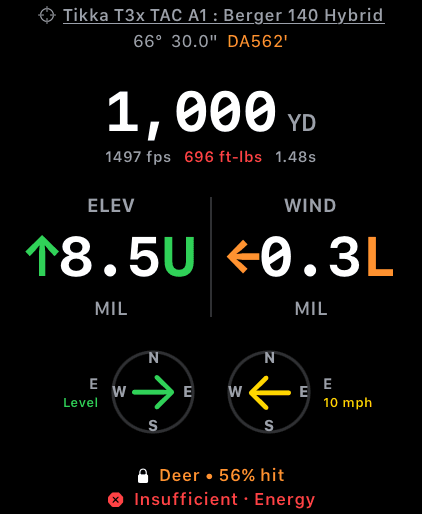
Wrist Dope runs both gates on every solution and shows the result as one of four bands with the limiting gate named: Ideal, Adequate, Marginal, or Insufficient. On the watch it sits under the hit line as Insufficient · Energy. On the iPhone the gate word is dropped for space and the limiting number in the velocity and energy row is tinted instead.
Ideal
25 percent or more headroom on the thinner gate. Take it.
Adequate
At or above the published minimum. Take it.
Marginal
Within 15 percent below the minimum. Caution. You are past the published line.
Insufficient
More than 15 percent below the minimum. Don't.
What you will never see is a percentage chance of a kill. That was a deliberate decision and it is worth saying plainly: the three things that most decide whether an animal dies quickly are where the bullet lands, the angle it enters at, and how the bullet is built. A watch cannot observe any of them. A readout saying 73 percent lethal would look precise and mean nothing, and a hunter who trusted it would be trusting arithmetic in place of judgment. A band derived from two published thresholds is a smaller claim, and it is one the device can actually stand behind.
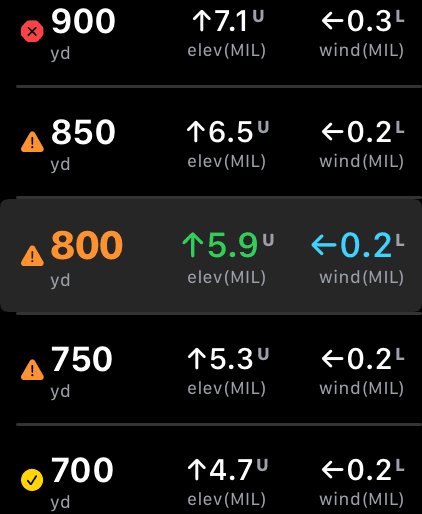
Both frames are a 6.5 Creedmoor with a 140 gr match bullet, not the .308 in the charts above, so the yardages differ. The watch range card shows the band as a glyph beside each row; the velocity and energy columns are on the iPhone card. Varmint presets show the band on its own, because the expansion gate is switched off for them and only the energy gate applies.
The second distance
Terminal performance is a ceiling, not a permission slip
Everything above assumes the bullet lands in the vitals. That assumption is doing enormous work, and it is the part of the question hunters are least honest with themselves about. So the app computes a second number next to the band: the probability that this rifle, this load and this wind call put the bullet inside the vital zone you picked. Both numbers need a locked target, and the vital-zone preset is what feeds them.
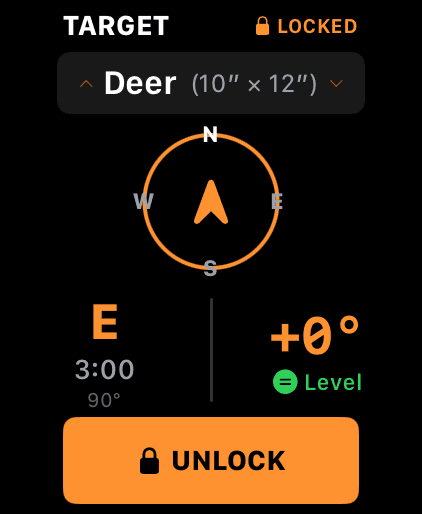
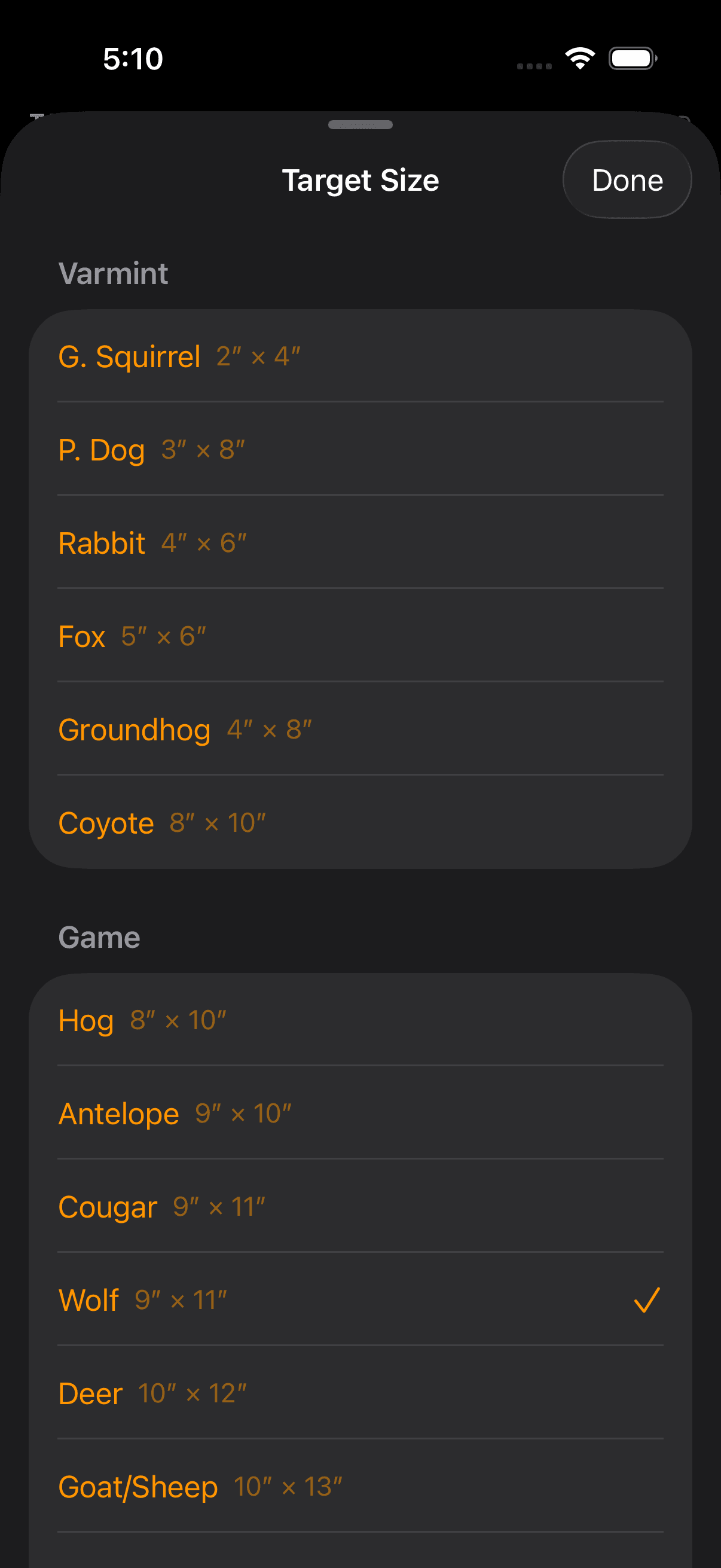
Three things set the hit percentage, and none of them is your confidence:
- 1
Your rifle's group size.
The extreme spread of a five-shot group at 100 yards, which the app converts to a per-axis dispersion and scales with distance. A new load starts at 1.00 inch until you measure your own.
- 2
Your ammunition's velocity spread.
The standard deviation of your muzzle velocity, 20 fps by default. It shows up as vertical error only, because a round that leaves slow spends longer falling and lands low.
- 3
How well you called the wind.
Not the wind speed, the uncertainty in your estimate of it, in miles per hour. This is usually the biggest single term at distance, and it is the one input that is purely a judgment about yourself.
Watch what happens to both numbers at the same time. Below, a 1,000 yard shot on a deer-sized target across a full-value 10 mph crosswind reads 33 percent hit and Insufficient, with 799 ft-lbs at the animal. On the range card below it, retained energy does not climb back over 1,000 ft-lbs until the 800-yard row, and even that row still carries an orange warning, because at 1,766 fps the bullet is under its expansion speed. Both numbers are telling you the same thing from different directions.
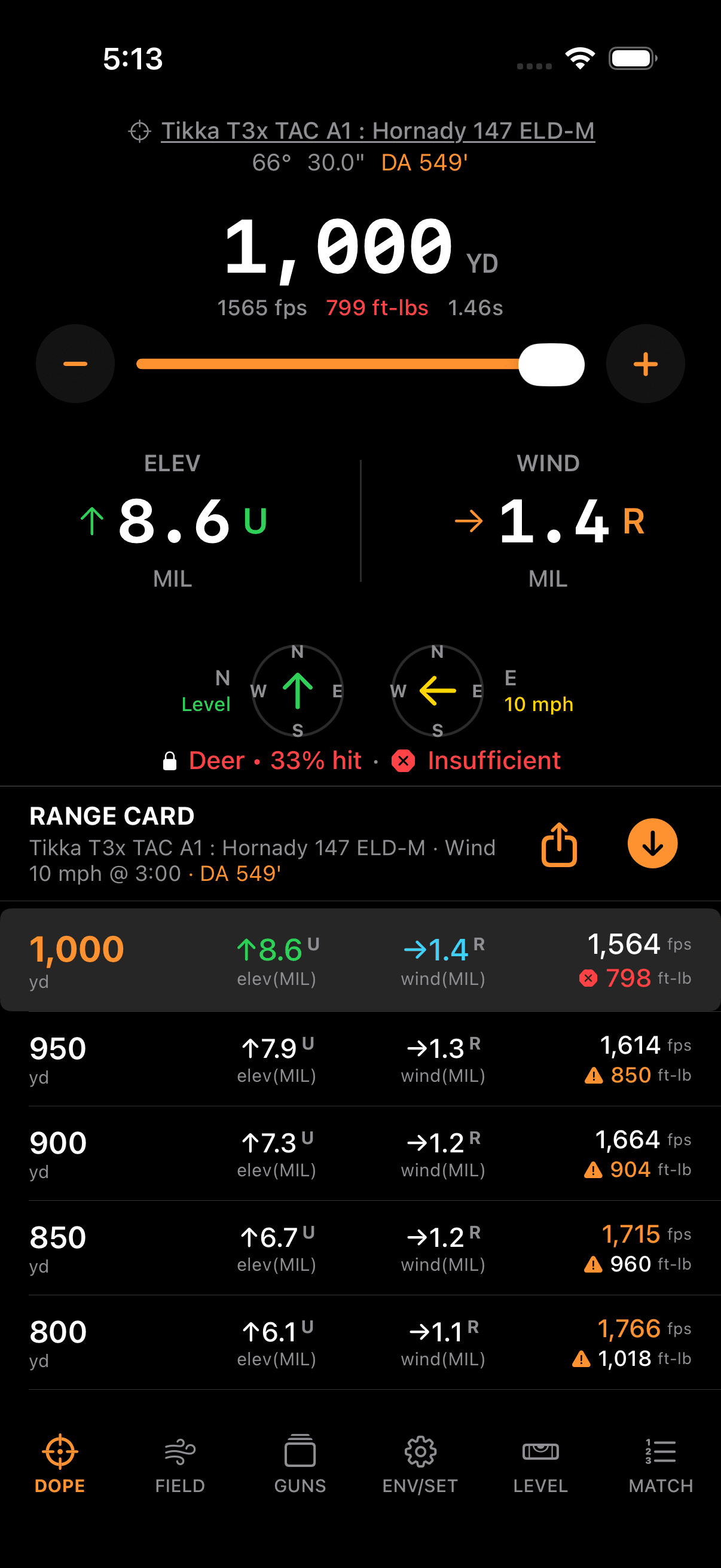
Do not compare that 33 percent with the 56 percent on the watch frame above. The watch shot is set up with the wind coming straight down the line of fire, where a bad wind call barely moves the bullet; the phone shot has the same wind at a full 90 degrees to it. Same rifle class, same wind speed, completely different exposure to your own error. Neither the hit percentage nor the terminal band is part of Pro. Both are there for everyone.
The arithmetic behind that percentage, and why velocity spread and wind confidence dominate at different distances, is its own article. How the hit percentage is computed.
Putting it together
Your ethical maximum is the shorter of the two
Two distances, and the smaller one wins. Terminal performance says how far the bullet can still do its job on arrival. Hit percentage says how far you can still be counted on to send it to the right place. For the .308 in these charts the first is 500 yards on a deer. The second depends entirely on you, your rifle, and the wind you are standing in, and for the great majority of hunters in the great majority of conditions it is the shorter of the two by a wide margin.
Both of them sit underneath the thing that actually matters, which is where the bullet lands. No amount of retained energy rescues a bullet in the paunch, and a modest load through both lungs kills as surely as a magnum does. Energy and expansion speed describe what a well-placed bullet is able to finish; they never substitute for the placement itself.
Neither number gives you permission. A quartering-away animal at 200 yards is a different proposition from a facing shot at the same range, and no thresholds account for the branch you did not see. The rating is a ceiling on the best case. Everything below the ceiling is judgment, and the most respectable thing a hunter does all season is take the rifle down off the pack and let the animal walk.
The takeaway
The numbers are the easy part. The decision is still yours.
No sensor makes a shot ethical. The barometer on your wrist can read the air, and the solver can tell you the bullet will arrive with 696 ft-lbs and no expansion speed left, but nothing on your arm knows how the animal is standing, how steady your position is, or whether you have practiced at that distance this year. Those are the parts that decide the outcome, and they belong to you.
What Wrist Dope can do is refuse to let the honest numbers be a surprise. Lock the vital-zone preset for what you are hunting and the watch carries two things next to your dope at the moment you are deciding: the terminal band with the gate that limits it, and the probability you put the bullet where it needs to go. Neither is behind Pro. They will not tell you to shoot. They will make it much harder to talk yourself into a shot you already know is too long.
Common questions
- How far can you ethically shoot a deer?
- There is no universal yardage. Our engine holds a .308 Winchester 175 gr load above the whitetail energy floor to 631 yards, but the same bullet slows past its 1,800 fps expansion speed at 500 yards, so terminal performance caps that load near 500. Your hit probability on a 10 by 12 inch vital zone almost always runs out first, and for most hunters it runs out far closer than either number.
- How many ft-lbs does it take to kill a deer?
- The number hunters settle on most often is 1,000 ft-lbs of retained energy at the animal for whitetail-sized game, and that is the floor Wrist Dope uses for its deer presets. It is a published rule of thumb, not a law of physics. Deer are killed every season with less and lost every season with more. Energy buys you penetration to the vitals; it does not aim the bullet.
- What is more important, shot placement or energy?
- Placement, and it is not close. Energy and impact velocity only describe what the bullet can do once it arrives in the right place. A well-placed bullet with modest energy kills cleanly; a high-energy bullet through the paunch does not. Every number on this page is a ceiling on what good placement can accomplish, never a substitute for it.
- Does a hunting bullet need a minimum velocity to expand?
- Yes. Expansion is what turns a bullet hole into a wound channel, and a bullet that arrives too slow can pencil through. Around 1,800 fps is the widely published floor for standard cup-and-core bullets. Bonded and premium designs open lower, near 1,600 fps. Wrist Dope rates every load against the conservative 1,800 fps figure, so it is never optimistic about a bullet it cannot inspect.
- Is the terminal rating in Wrist Dope a kill probability?
- No, and that is deliberate. The app shows a four-level band, Ideal, Adequate, Marginal or Insufficient, computed from retained energy and impact velocity. It never prints a percentage chance of a kill, because the biggest factors, where the bullet lands, the angle of the animal, and how the bullet is built, are things a watch cannot observe.
The other half of the ethical distance question is how likely you are to hit at all. How the hit percentage is computed, from group size, velocity spread and your wind call.