
Manual / Airgun Setup
Airgun Setup
Wrist Dope solves an air rifle the same way it solves a magnum: same engine, same atmosphere, same holds. What changes is the scale. Pick an airgun caliber from the list and the app sizes itself down for you, starting with a 30 m zero and a real pellet. Here is the whole setup, and the two places you still have to do the work.
Pick, don't type
The smart defaults key off the cartridge list. A hand-typed caliber gets none of them.
Then the tin
The seeded pellet is a starting point. Your weight, your BC, your chronograph.
Trim the card
The range card starts at 100 yd steps. Airgun distances need a minimum, a maximum and a step.
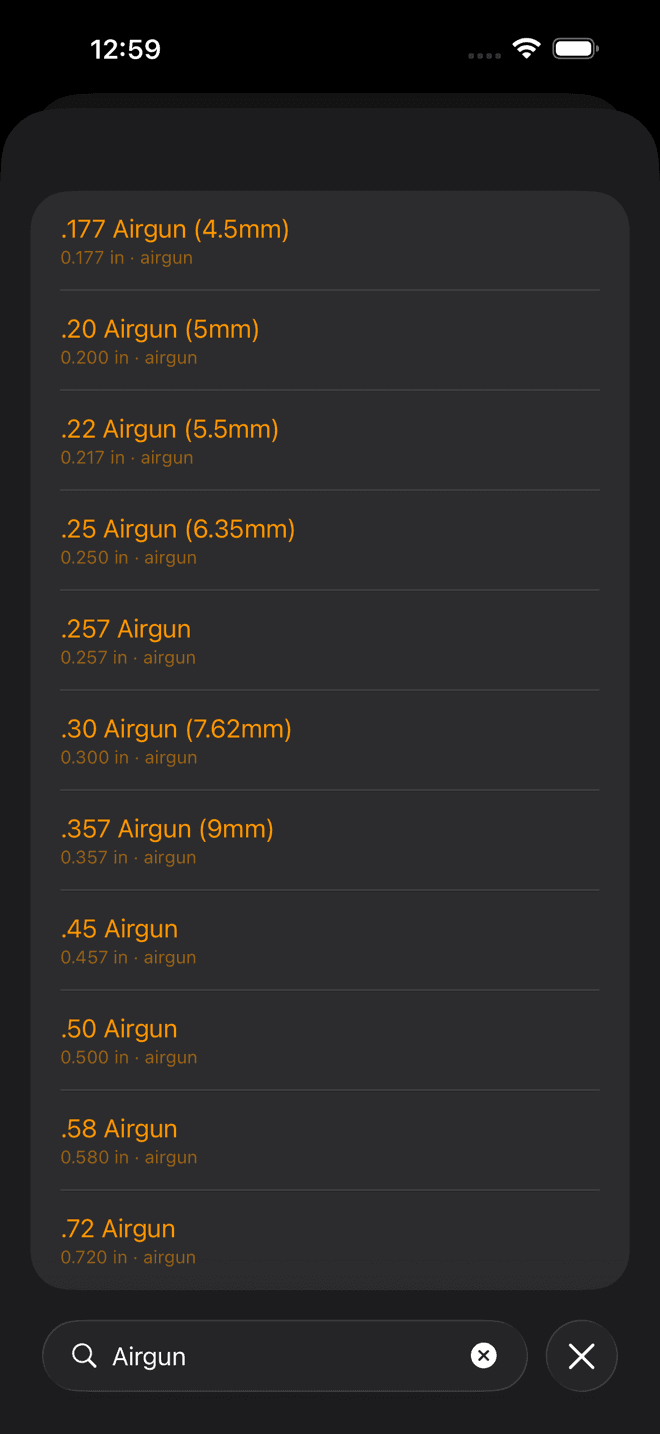
Search “airgun” in the cartridge picker. All eleven bores fit on one screen.
Start here
Pick the caliber from the list
Add Gun on the GUNS page, then tap Cartridge. The list opens on common centrefire rounds, so type airgun in the search field. Your bore diameter and metric size are both in the name, and you can search either: 5.5mm and .22 Pellet both find the same entry.
This one step is what makes the rest of the page happen. Wrist Dope decides “this is an airgun” by looking the chosen cartridge up in its own database at the moment you pick it. There is no airgun switch anywhere in the app. Type a name the database doesn't know, like “.22 PCP” or “my Impact”, and you get an ordinary rifle profile with none of the defaults below.
Eleven bores are listed:
- .177 Airgun (4.5 mm)
- .20 Airgun (5 mm)
- .22 Airgun (5.5 mm)
- .25 Airgun (6.35 mm)
- .257 Airgun
- .30 Airgun (7.62 mm)
- .357 Airgun (9 mm)
- .45 Airgun
- .50 Airgun
- .58 Airgun
- .72 Airgun
They run smallest bore to largest, from the .177 target pellet to the .72 slug guns. If your rifle is a slug gun in a bore that also shoots pellets, pick the bore. The projectile is described on the load, not the rifle.
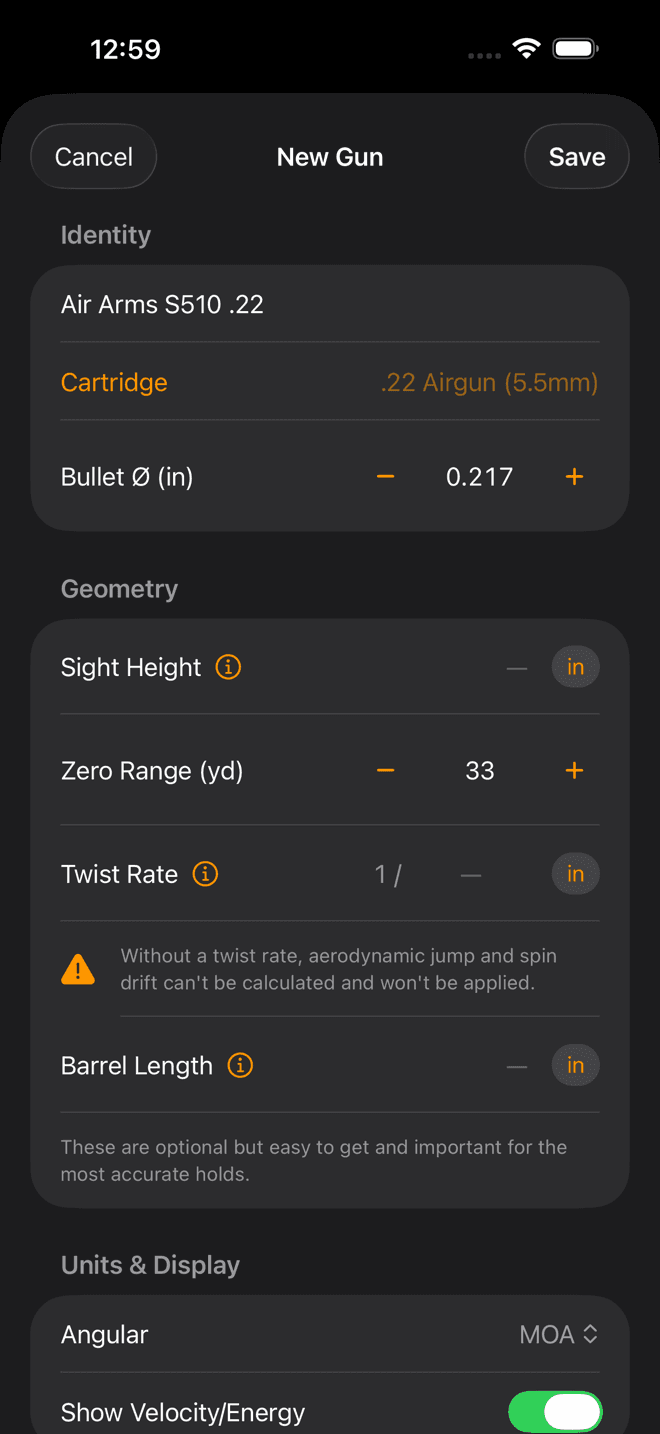
Zero Range came up at 33 yd, not 100. That is 30 m, the airgun standard, held in yards.
What you get
The app fills in the airgun-sized numbers
Pick an airgun caliber on a new rifle and four things change from their rifle values:
- Zero range comes up at 33 yd instead of 100. That is 30 m rounded to the nearer yard. Switch the app to metric and the same rifle reads 30 m.
- The first load arrives as a real pellet for that bore rather than a 168 gr match bullet. More on that below.
- The FIELD target becomes small quarry, so hit percentage and the terminal rating are sized for what an air rifle shoots.
- The Live Fire dial starts at 50 rather than 450, because airgun engagement is roughly 25 to 75.
These are defaults, not a mode. Every one stays a plain editable field afterwards. The target and the dial are only seeded if you have never chosen them yourself, and anything you had already typed into the new rifle survives a late change of cartridge.
Three fields the app cannot guess are still yours. Set sight height: airgun scopes sit high, and a 2 in fallback is a poor stand-in when your rings put the optic at 2.5 in over a springer's bore. Add a twist rate if you know it, or spin drift and aerodynamic jump stay switched off. Barrel length is optional here. The velocity estimator deliberately refuses airguns, because a pre-charged rifle's muzzle velocity comes from its regulator and valve, not from a powder charge and a barrel length.
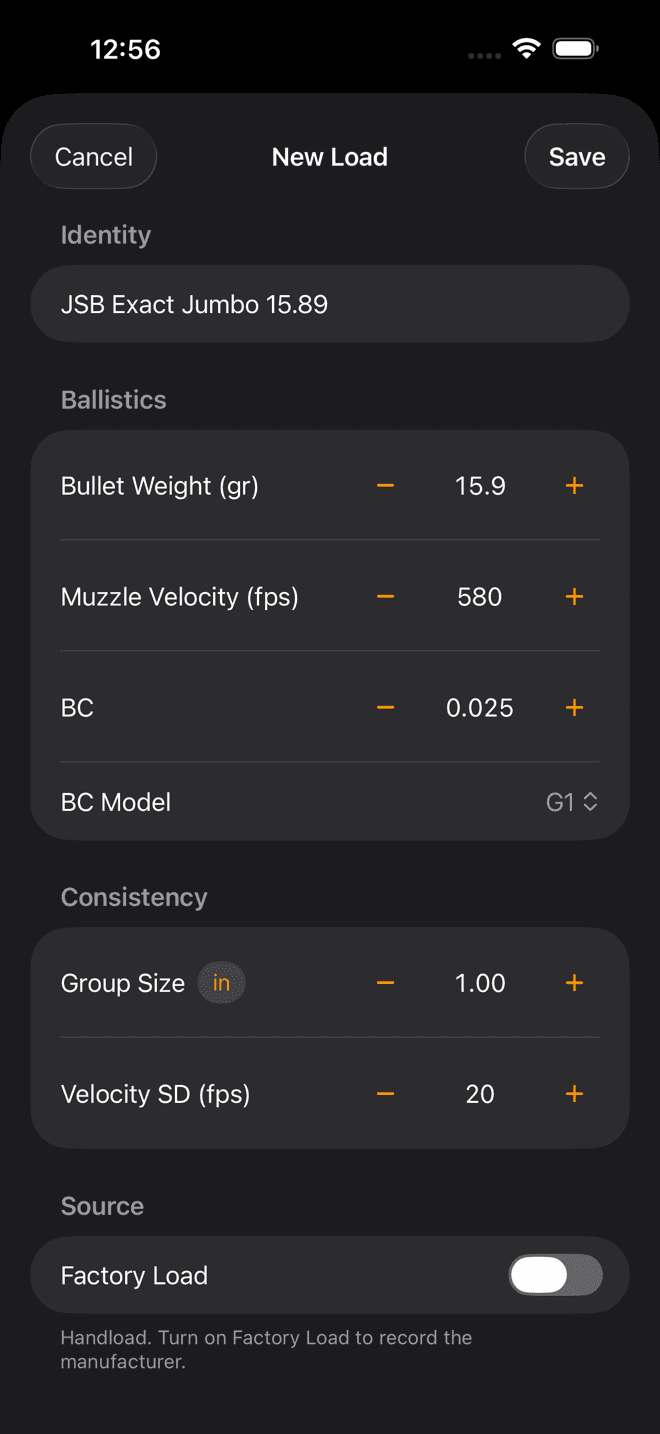
Add Load on an airgun opens on a real pellet: here 15.9 gr at 580 fps, BC 0.025 on G1.
The pellet
A starting pellet you then replace
Every airgun bore has a starting pellet or slug behind it: a de-facto-standard pellet at a typical sporting velocity for the smallbores, a representative production slug for the big bores. It is a seed, not a claim about your rifle. Replace all three numbers with the tin in your hand and a chronograph reading.
The entry fields are built for those numbers rather than centrefire ones:
- Pellet weight takes tenths of a grain, because tins are sold that way. It displays them, and a rifle bullet still shows as a whole number.
- Ballistic coefficient reads to three decimals and goes down to 0.005, which is well below the 0.01 to 0.045 a diabolo pellet lives in.
- Muzzle velocity accepts 300 fps, or 90 m/s. That is low enough for a sub-12 ft-lbs rifle.
- Energy keeps a decimal below about 30 ft-lbs. Whole numbers throw away the resolution that matters when the legal ceiling is 12.
One honest limitation on the drag model. Wrist Dope solves pellets on G1, which is what pellet makers quote their BCs against and what the tin usually prints. G1 describes a flat-based reference bullet, not a diabolo pellet, so it is an approximation that a purpose-built pellet drag law would beat. The gap grows with range and speed: modest at 50 m, meaningful past 100 m, largest above about 900 fps. A pellet-specific drag model is researched and specified but not shipped. In the meantime the fix is the one that works for every load in this app: verify on paper at the distances you shoot, and true the load rather than trusting a published number.
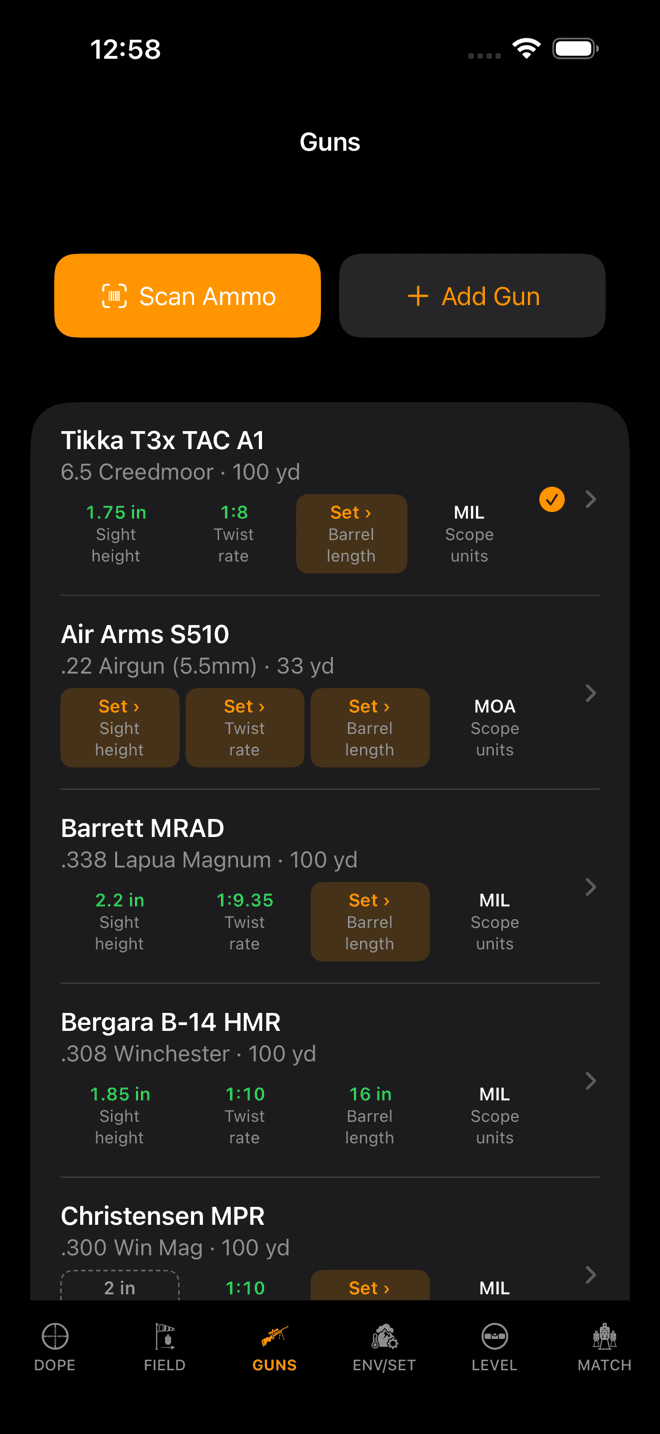
The airgun sits in the same list as the centrefires, with its own zero and its own scope units.
Alongside the rest
It is a rifle profile like any other
Nothing about the airgun is walled off. It shares the GUNS list, the same four setup chips, the same load-per-rifle structure, and the same export file, so it rides along in a backup and imports into the Android app.
Two per-rifle settings are worth a second look on an air rifle. Scope units are set here, not globally, so an airgun scope marked in MOA can sit next to a MIL centrefire without either being wrong. And Show Velocity/Energy adds retained velocity and energy columns to this rifle's card, which is the pair of numbers an airgun hunter actually reads.
Every field on this sheet is explained one by one in Guns and Loads. This page only covers what an airgun does differently.
A dope card that starts close
Out of the box the range card runs to 1,500 yd in 100 yd steps. For an air rifle that is one useful row and fourteen blank ones. Three settings in ENV/SET fix it, and they are global rather than per-rifle:
- Range Card Max Range offers 100, 150, 200 and 300 yd below the rifle options. Those four exist for exactly this.
- Range Card Min Range starts the card at 10, 25, 50 or 100 rather than 0, so the rows begin where you actually shoot.
- Range Card Increment goes down to 5 yd. At airgun distances a 100 yd step is the whole card in one line.
A 10 to 100 yd card in 5 yd steps is a reasonable place to start. Live Fire Step and Live Fire Max Range do the same job for the dial on the DOPE page. Every one of these rows is documented in Settings, and the card itself in Range Card and Dope Card.
Group size, and why the zero distance decides it
Group size on a load is the extreme spread of a five-shot group, measured at that rifle's zero range, not at a universal 100 yd. This matters more to airgunners than to anyone else. Shoot a 0.4 in group at a 25 yd zero and that is what you enter. If the app read the same 0.4 in as a 100 yd group it would believe your dispersion is four times tighter than it is, and every hit percentage it showed you would be a fantasy.
So set the zero range honestly first, then measure the group at that distance. Tap the unit chip on the row if you would rather type the group as an angle. What it feeds is explained in Hit Percentage.
Small quarry, and where the rating turns
Pick a rabbit, a ground squirrel or a prairie dog on the FIELD page and Wrist Dope rates the shot Ideal, Adequate, Marginal or Insufficient against retained energy at the target. The floors for these three are set at airgun-hunting minimums, single-digit foot-pounds, the world the sub-12 rifle was built for. A centrefire clears them by orders of magnitude and an air rifle does not.
That makes the rating a real range limit rather than decoration. Below is the app's own seeded .22 pellet (15.9 gr, BC 0.025 on G1, 580 fps, zeroed at 33 yd, standard atmosphere) solved by the Wrist Dope engine and rated against the 6 ft-lbs rabbit floor:
| Range | Pellet vs aim point | Retained energy | Rabbit rating |
|---|---|---|---|
| 25 yd | 0.8 in high | 9.2 ft-lbs | Ideal |
| 40 yd | 1.4 in low | 7.9 ft-lbs | Ideal |
| 50 yd | 4.8 in low | 7.1 ft-lbs | Adequate |
| 60 yd | 9.9 in low | 6.4 ft-lbs | Adequate |
| 75 yd | 21.3 in low | 5.4 ft-lbs | Marginal |
| 100 yd | 52.0 in low | 4.1 ft-lbs | Insufficient |
Your rifle and your pellet will not match that table. It is one worked example, not a recommendation. Enter your own numbers and read your own. The bands and the two gates behind them are covered in Hit Percentage.
It isn't behaving like an airgun
- The zero came up at 100 yd and the load is 168 gr. The cartridge was typed rather than picked, so the app never saw an airgun. Open
Edit Gun, tap Cartridge and choose the bore from the list. The defaults only fire on a new rifle, so set the zero yourself afterwards. - I picked the caliber but nothing changed. Seeding only touches fields still sitting at their rifle defaults, and only on a rifle you are creating. An existing rifle is never rewritten behind your back. Change the cartridge and everything else stays exactly as you left it.
- The range card is one row. Max range is still 1,500 with a 100 yd step. Set the maximum, the minimum and the increment in
ENV/SET. - Hit percentage looks far too good. Check that the zero range on the rifle is the distance you actually measured the group at. A 0.4 in group logged against a 100 yd zero reads as a rifle four times more precise than the one in your hands.
- Barrel length won't give me a velocity estimate. By design. The estimator is built on cartridge and barrel data that does not describe a regulated air rifle, so it declines rather than inventing a number. Chronograph the rifle, or true it on target.
- Wind holds ignore spin drift. No twist rate means no spin drift and no aerodynamic jump, on an airgun exactly as on a rifle. The chip on the GUNS row reads
Set ›until you fill it in.
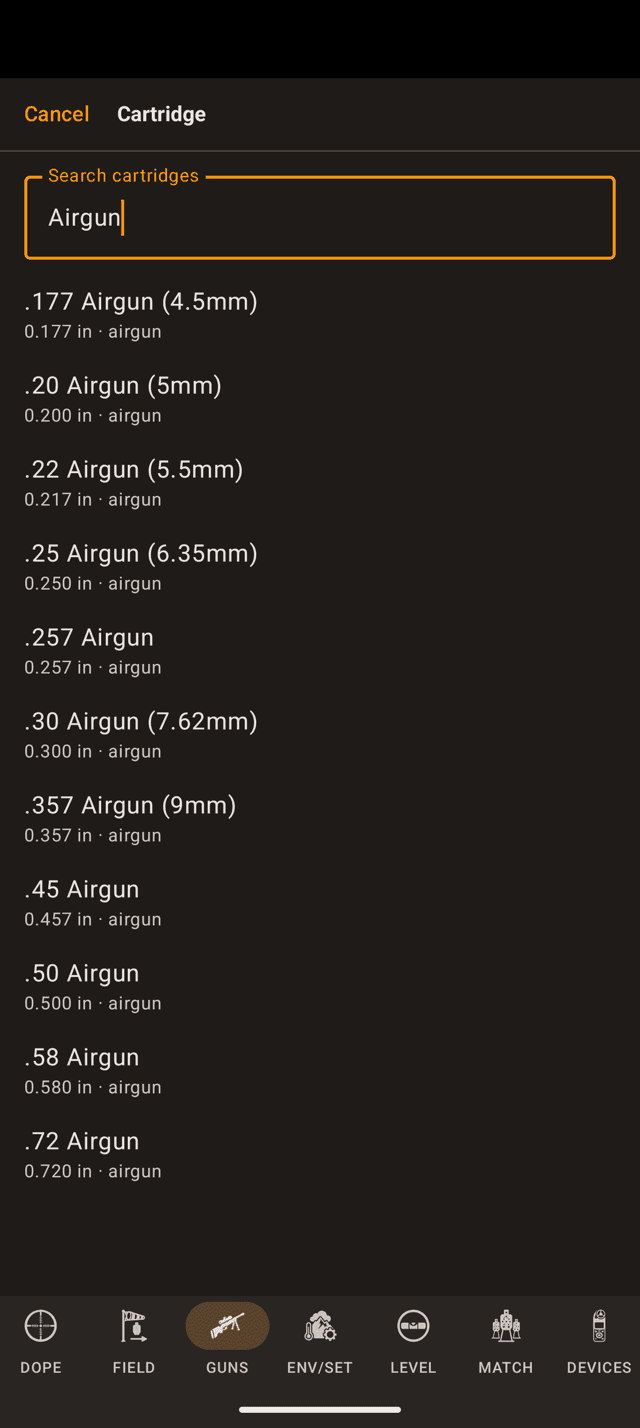
Search “airgun” in the cartridge picker. All eleven bores fit on one screen.
Start here
Pick the caliber from the list
Add Gun on the GUNS page, then tap Cartridge. The list opens on common centrefire rounds, so type airgun in the search field. Your bore diameter and metric size are both in the name, and you can search either: 5.5mm and .22 Pellet both find the same entry.
This one step is what makes the rest of the page happen. Wrist Dope decides “this is an airgun” by looking the chosen cartridge up in its own database at the moment you pick it. There is no airgun switch anywhere in the app. Type a name the database doesn't know, like “.22 PCP” or “my Impact”, and you get an ordinary rifle profile with none of the defaults below.
Eleven bores are listed:
- .177 Airgun (4.5mm)
- .20 Airgun (5mm)
- .22 Airgun (5.5mm)
- .25 Airgun (6.35mm)
- .257 Airgun
- .30 Airgun (7.62mm)
- .357 Airgun (9mm)
- .45 Airgun
- .50 Airgun
- .58 Airgun
- .72 Airgun
They run smallest bore to largest, from the .177 target pellet to the .72 slug guns. If your rifle is a slug gun in a bore that also shoots pellets, pick the bore. The projectile is described on the load, not the rifle.
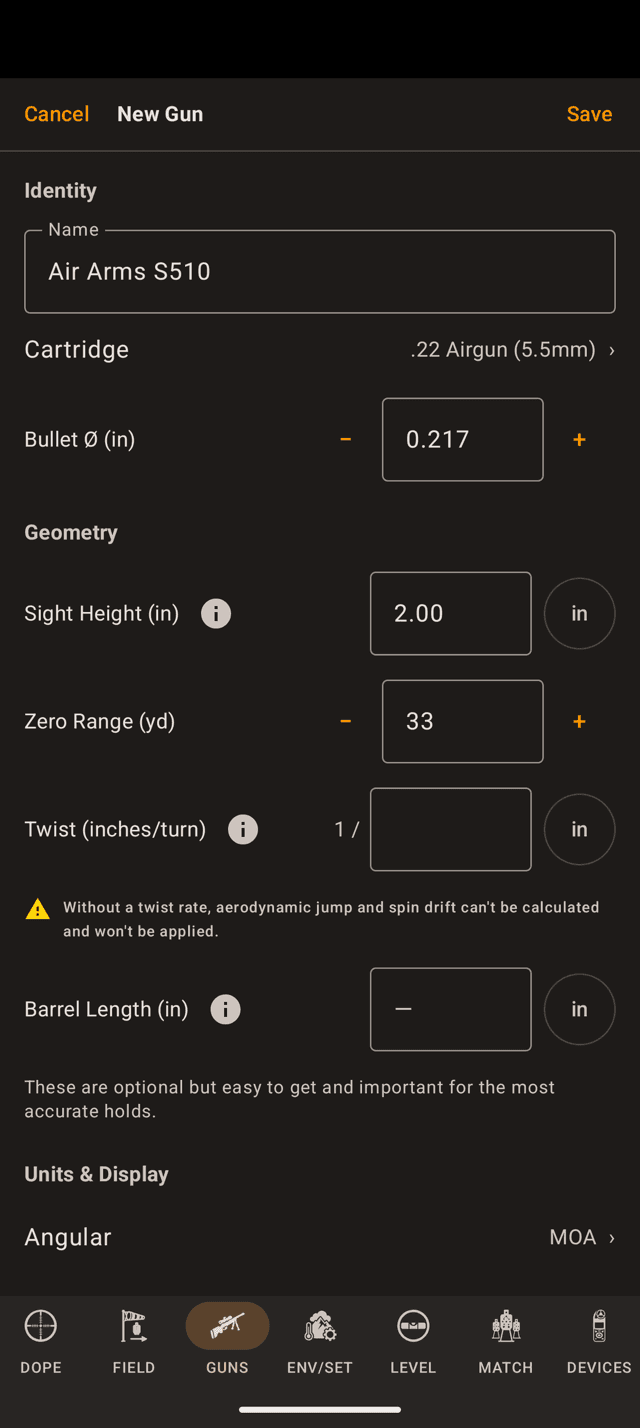
Zero Range came up at 33 yd, not 100. That is 30 m, the airgun standard, held in yards.
What you get
The app fills in the airgun-sized numbers
Pick an airgun caliber on a new rifle and two things change from their rifle values:
- Zero range comes up at 33 yd instead of 100. That is 30 m rounded to the nearer yard. Switch the app to metric and the same rifle reads 30 m.
- The first load arrives as a real pellet for that bore rather than a 168 gr match bullet. More on that below.
Both happen whether you create the rifle on the phone or on the watch. The FIELD target and the Live Fire dial are not changed for you on Android: pick small quarry on the FIELD page, and dial in to airgun distances yourself.
These are defaults, not a mode. Both stay plain editable fields afterwards, and anything you had already typed into the new rifle survives a late change of cartridge.
Three fields the app cannot guess are still yours. Set sight height: airgun scopes sit high, and a 2 in fallback is a poor stand-in when your rings put the optic at 2.5 in over a springer's bore. Add a twist rate if you know it, or spin drift and aerodynamic jump stay switched off. Barrel length is optional here. The velocity estimator deliberately refuses airguns, because a pre-charged rifle's muzzle velocity comes from its regulator and valve, not from a powder charge and a barrel length.
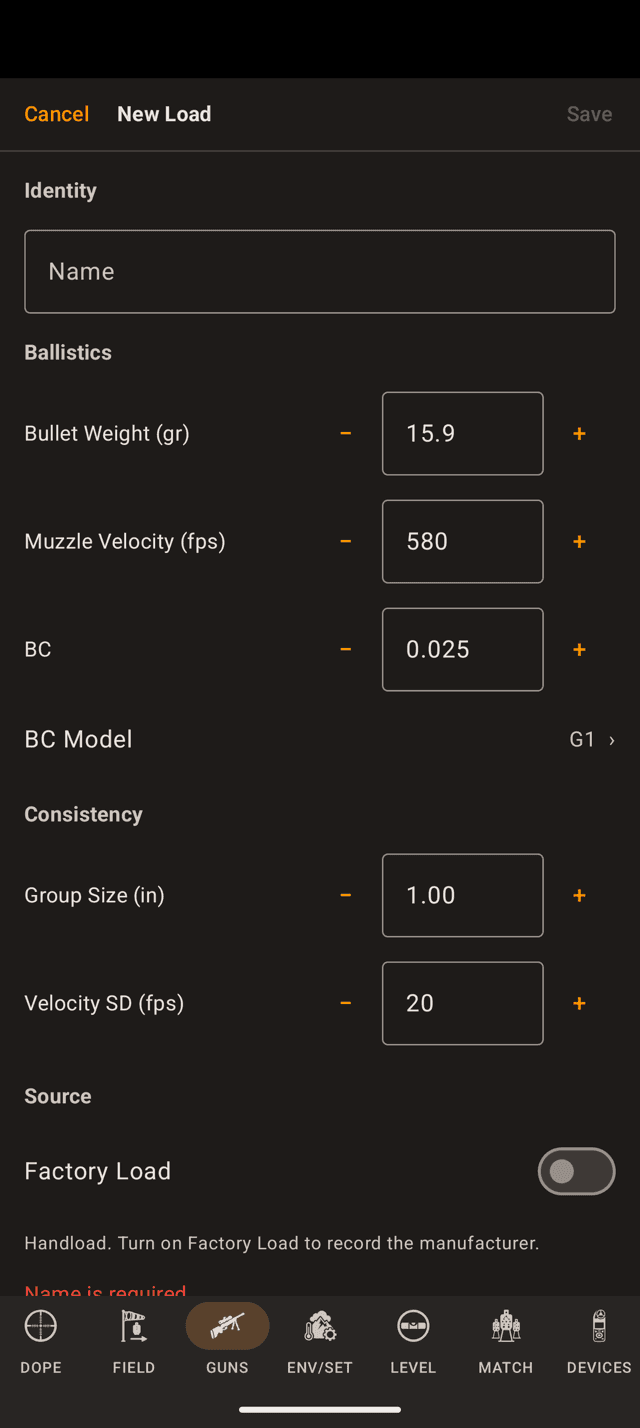
Add Load on an airgun opens on a real pellet: here 15.9 gr at 580 fps, BC 0.025 on G1. Give it a name to save it.
The pellet
A starting pellet you then replace
Every airgun bore has a starting pellet or slug behind it: a de-facto-standard pellet at a typical sporting velocity for the smallbores, a representative production slug for the big bores. It is a seed, not a claim about your rifle. Replace all three numbers with the tin in your hand and a chronograph reading.
The entry fields are built for those numbers rather than centrefire ones:
- Pellet weight takes tenths of a grain, because tins are sold that way.
- Ballistic coefficient reads to three decimals and goes down to 0.005, which is well below the 0.01 to 0.045 a diabolo pellet lives in.
- Muzzle velocity accepts 300 fps, or 90 m/s. That is low enough for a sub-12 ft-lbs rifle.
- Energy keeps a decimal below about 30 ft-lbs. Whole numbers throw away the resolution that matters when the legal ceiling is 12.
One honest limitation on the drag model. Wrist Dope solves pellets on G1, which is what pellet makers quote their BCs against and what the tin usually prints. G1 describes a flat-based reference bullet, not a diabolo pellet, so it is an approximation that a purpose-built pellet drag law would beat. The gap grows with range and speed: modest at 50 m, meaningful past 100 m, largest above about 900 fps. A pellet-specific drag model is researched and specified but not shipped. In the meantime the fix is the one that works for every load in this app: verify on paper at the distances you shoot, and true the load rather than trusting a published number.
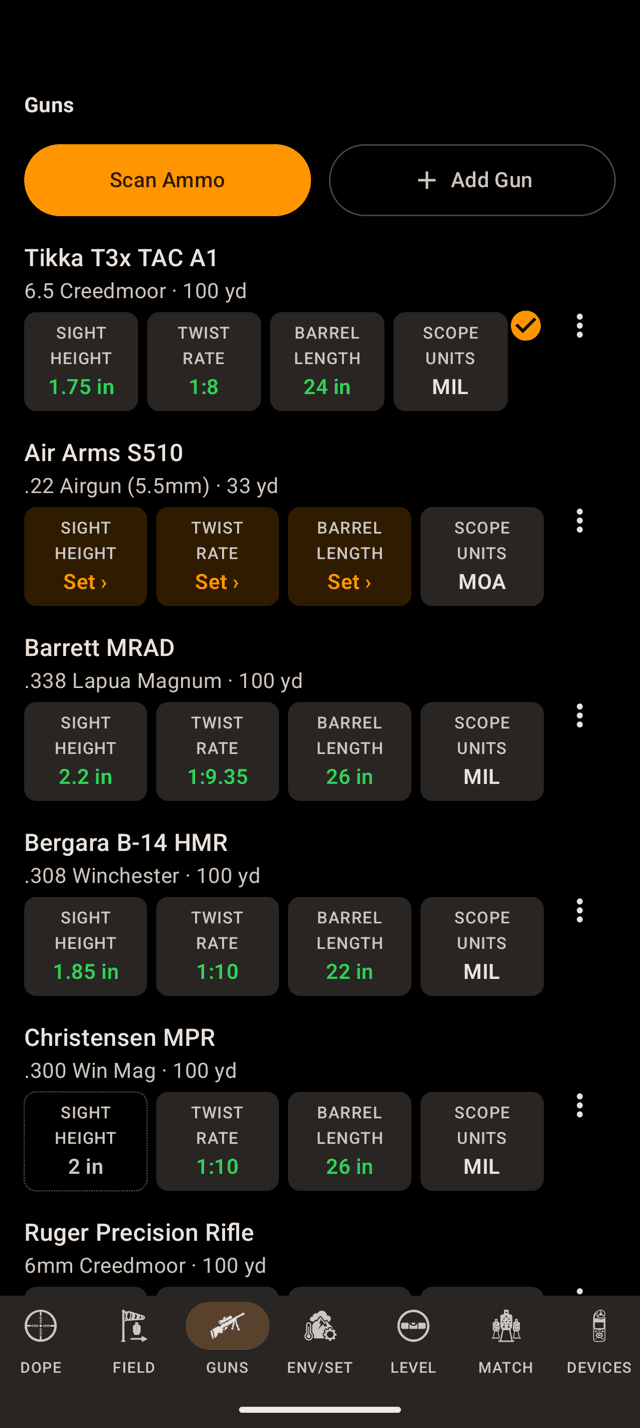
The airgun sits in the same list as the centrefires. Its orange Set › chips are the fields still to fill in.
Alongside the rest
It is a rifle profile like any other
Nothing about the airgun is walled off. It shares the GUNS list, the same four setup chips, the same load-per-rifle structure, and the same export file, so it rides along in a backup and imports into the iPhone app.
Two per-rifle settings are worth a second look on an air rifle. Scope units are set here, not globally, so an airgun scope marked in MOA can sit next to a MIL centrefire without either being wrong. A new rifle starts in MOA on a phone set to imperial units, so check it against your turrets. And Show Velocity/Energy adds retained velocity and energy columns to this rifle's card, which is the pair of numbers an airgun hunter actually reads.
Every field on this sheet is explained one by one in Guns and Loads. This page only covers what an airgun does differently.
A dope card that starts close
Out of the box the range card runs to 1,500 yd in 100 yd steps. For an air rifle that is one useful row and fourteen blank ones. Three settings in ENV/SET fix it, and they are global rather than per-rifle:
- Range Card Max Range offers 100, 150, 200 and 300 yd below the rifle options. Those four exist for exactly this.
- Range Card Min Range starts the card at 10, 25, 50 or 100 rather than 0, so the rows begin where you actually shoot.
- Range Card Increment goes down to 5 yd. At airgun distances a 100 yd step is the whole card in one line.
A 10 to 100 yd card in 5 yd steps is a reasonable place to start. Live Fire Step and Live Fire Max Range do the same job for the dial on the DOPE page. On the watch the same three live in Settings, under Range Card: Min Range, Max Range and Increment. Every one of these rows is documented in Settings, and the card itself in Range Card and Dope Card.
Group size, and why the zero distance decides it
Group size on a load is the extreme spread of a five-shot group, measured at that rifle's zero range, not at a universal 100 yd. This matters more to airgunners than to anyone else. Shoot a 0.4 in group at a 25 yd zero and that is what you enter. If the app read the same 0.4 in as a 100 yd group it would believe your dispersion is four times tighter than it is, and every hit percentage it showed you would be a fantasy.
So set the zero range honestly first, then measure the group at that distance. A new load starts at 1.00 in, which is a placeholder for a centrefire, not a measurement of your air rifle. What it feeds is explained in Hit Percentage.
Small quarry, and where the rating turns
Pick a rabbit, a ground squirrel or a prairie dog on the FIELD page and Wrist Dope rates the shot Ideal, Adequate, Marginal or Insufficient against retained energy at the target. The floors for these three are set at airgun-hunting minimums, single-digit foot-pounds, the world the sub-12 rifle was built for. A centrefire clears them by orders of magnitude and an air rifle does not.
That makes the rating a real range limit rather than decoration. Below is the app's own seeded .22 pellet (15.9 gr, BC 0.025 on G1, 580 fps, zeroed at 33 yd, standard atmosphere) solved by the Wrist Dope engine and rated against the 6 ft-lbs rabbit floor:
| Range | Pellet vs aim point | Retained energy | Rabbit rating |
|---|---|---|---|
| 25 yd | 0.8 in high | 9.2 ft-lbs | Ideal |
| 40 yd | 1.4 in low | 7.9 ft-lbs | Ideal |
| 50 yd | 4.8 in low | 7.1 ft-lbs | Adequate |
| 60 yd | 9.9 in low | 6.4 ft-lbs | Adequate |
| 75 yd | 21.3 in low | 5.4 ft-lbs | Marginal |
| 100 yd | 52.0 in low | 4.1 ft-lbs | Insufficient |
Your rifle and your pellet will not match that table. It is one worked example, not a recommendation. Enter your own numbers and read your own. The bands and the two gates behind them are covered in Hit Percentage.
It isn't behaving like an airgun
- The zero came up at 100 yd and the load is 168 gr. The cartridge was typed rather than picked, so the app never saw an airgun. Open
Edit Gun, tap Cartridge and choose the bore from the list. The defaults only fire on a new rifle, so set the zero yourself afterwards. - I picked the caliber but nothing changed. Seeding only touches fields still sitting at their rifle defaults, and only on a rifle you are creating. An existing rifle is never rewritten behind your back. Change the cartridge and everything else stays exactly as you left it.
- The FIELD target and the dial are still on rifle numbers. Expected. Picking an airgun sets the zero and the starting pellet, and leaves the target and the dial alone. Choose the quarry on the FIELD page and dial in close yourself.
- The range card is one row. Max range is still 1,500 with a 100 yd step. Set the maximum, the minimum and the increment in
ENV/SET. - Hit percentage looks far too good. Check that the zero range on the rifle is the distance you actually measured the group at. A 0.4 in group logged against a 100 yd zero reads as a rifle four times more precise than the one in your hands.
- Barrel length won't give me a velocity estimate. By design. The estimator is built on cartridge and barrel data that does not describe a regulated air rifle, so it declines rather than inventing a number. Chronograph the rifle, or true it on target.
- Wind holds ignore spin drift. No twist rate means no spin drift and no aerodynamic jump, on an airgun exactly as on a rifle. The chip on the GUNS row reads
Set ›until you fill it in.
One honest caveat: a solution is a prediction, and a pellet solved on a rifle bullet's drag curve is a rougher prediction than most. Confirm it on paper at the distances you hunt before you take it into the field, know your quarry and your backstop, and shoot within the law.
Still stuck? support@wristdope.com